



Hypnotherapy treats specific phobias by accessing the subconscious fear file directly — the automatic association between a trigger (height, elevator, airplane) and a physical alarm response — and repatterning it before the conscious mind has time to intervene. This is why logical reassurance (“I know it’s safe”) rarely eliminates a phobia: the fear lives below the level of logic. Hypnotherapy in Fort Lauderdale for phobias works with the nervous system’s threat-detection layer, updating the subconscious’s assessment of what is and isn’t dangerous. Most specific phobias respond well within 2–4 sessions.
You know it’s not dangerous. You’ve told yourself that. You may have explained it to others with perfect logic. And then the elevator doors close, or the plane starts its descent, or the bridge appears on the GPS — and your body completely ignores everything your rational mind just said.
That’s not a failure of willpower or intelligence. That’s the subconscious phobia response working exactly as it was designed to — just pointing in the wrong direction.

Why Logic Doesn’t Fix Phobias
Specific phobias are stored in the subconscious as threat files. They operate through the body’s fear-detection system, which fires faster than conscious thought. By the time your logical mind has formed the sentence “this is statistically safe,” the body has already flooded with adrenaline.
Think of it using the iceberg model. The conscious mind — the part that reasons, reassures, and reads statistics — sits at the tip. The phobia lives below the waterline, an automatic emotional memory. It was learned through experience, often a single moment of intense fear that the subconscious hard-drive filed under: “this = danger, always.”
Talking about it, understanding it, even accepting it — these are conscious-mind activities. The phobia doesn’t live there. This is why hypnotherapy for phobias and fears is often more direct than talk-based approaches: it communicates with the part of the mind where the fear was filed.
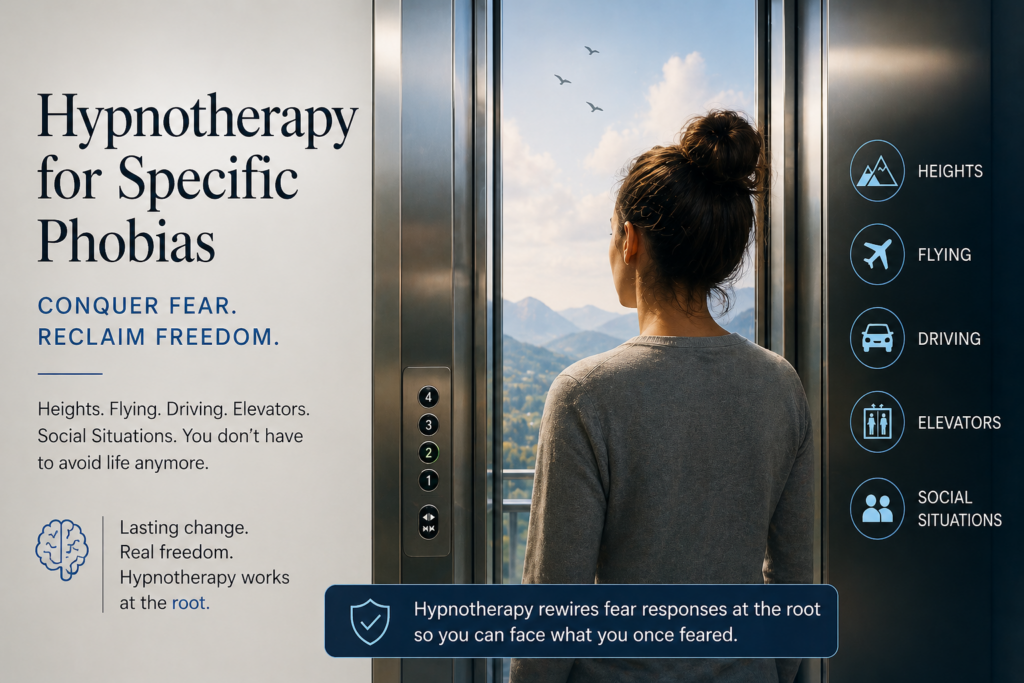
Common Specific Phobias Hypnotherapy Addresses
Fear of Heights (Acrophobia)
The body’s response to heights — dizziness, frozen legs, the urge to drop low — is a survival mechanism. For most people it’s calibrated appropriately. For those with acrophobia, the threshold is set so sensitively that even a second-floor balcony or a glass elevator triggers a full alarm. Hypnotherapy recalibrates that threshold without requiring exposure to extreme heights.
Fear of Flying (Aviophobia)
Flying phobia often combines multiple subconscious fears: enclosed space, loss of control, the physical sensations of turbulence mimicking panic. Many people avoid travel entirely or endure flights in a state of sustained terror. Hypnotherapy addresses each layer of the fear response, including the anticipatory anxiety that begins days before a scheduled flight.
Driving Anxiety and Highway Panic
For many South Florida residents, driving anxiety on I-95 and major highways represents a phobia that directly limits daily life. The driving anxiety and panic response follows a predictable subconscious loop: a past moment of panic on a highway gets filed as “highways = emergency,” and the nervous system faithfully enforces that file every time the situation recurs.
Elevator Phobia (Claustrophobia)
Elevator and enclosed-space phobias are among the most life-limiting specific phobias in an urban environment. The fear is usually about the sensation of being trapped, not the elevator itself. The subconscious has generalized from a moment of real or perceived confinement to anything that feels structurally similar. Hypnotherapy helps the nervous system differentiate between genuine danger and safe constraint.
Social Anxiety and Fear of Judgment
Social phobia operates slightly differently from situational phobias — the trigger is interpersonal rather than environmental. But the structure is the same: a subconscious belief (“I will be judged and found lacking”) fires a threat response whenever visibility or evaluation is present. This connects naturally with hypnotherapy for anxiety and confidence work, because the root is often an identity-level belief formed early in life.
How Hypnotherapy Reprograms the Phobia Response
A hypnotherapy session for a specific phobia doesn’t ask you to expose yourself to the feared situation while panicking. It works with the subconscious representation of the fear — the file — rather than the situation itself.
The process typically moves through:
- Mapping the fear response — when it started, what it feels like in the body, what the trigger really is
- Accessing the subconscious origin — the experience where the fear file was first saved
- Processing what got frozen in that moment — the shock, helplessness, or overwhelm that became the fear’s anchor
- Updating the subconscious’s threat assessment — so the elevator, plane, or highway is correctly filed as “safe”
- Installing a new automatic response — calm, grounded, capable — that fires in place of panic
Clients across Broward County come to these sessions from Hollywood, Pompano Beach, and the wider Fort Lauderdale area. Virtual sessions work equally well — the subconscious responds to imagination as readily as to physical presence, which is precisely why phobia work is possible without re-exposure.
Frequently Asked Questions
How many sessions does it take to treat a specific phobia with hypnotherapy?
Most specific phobias respond within 2–4 sessions when the fear is relatively isolated. More complex presentations — phobias layered with generalized anxiety or connected to earlier trauma — may take longer. A realistic timeline is discussed after your first session.
Do I have to be exposed to the thing I’m afraid of during the session?
No. Hypnotherapy works with the subconscious representation of the fear, not the situation itself. You won’t be placed in an elevator or asked to watch videos of heights. The work happens at the level of the nervous system’s internal response.
Can hypnotherapy help with social anxiety specifically?
Yes. Social anxiety has the same subconscious structure as situational phobias — an automatic threat response triggered by social visibility or evaluation. Hypnotherapy addresses the identity-level belief driving that response, which often produces more durable change than symptom management alone.
I’ve had this phobia my whole life — can it actually change?
Yes. The duration of a phobia doesn’t determine whether it can change — it determines how long the subconscious file has been in place. Long-standing phobias often have deeper emotional anchors, but they update through the same process. The subconscious doesn’t have a statute of limitations.
Are virtual sessions effective for phobia treatment?
Very much so. Because phobia work targets the internal subconscious response rather than requiring in-vivo exposure, virtual sessions are fully effective. Clients in Hollywood FL, Pompano Beach, and across South Florida regularly complete phobia work through virtual hypnotherapy.