



Your genes are not a fixed sentence. Research in epigenetics shows that trauma, chronic stress, and emotional states can alter how your genes express themselves — and that this can even be passed to the next generation. The good news: the same mechanism that encodes trauma can be used to reverse it. The environment your cells live in matters more than the genes themselves.
Most of us were taught a simple story about genes: you’re born with them, they determine who you are, and there isn’t much you can do about it. If anxiety runs in your family, well — that’s just your biology. If depression shows up in every generation, it’s in the DNA
I believed that story too, once. Medical school reinforced it.
But the longer I worked in behavioral healthcare, and eventually in clinical hypnotherapy, the more that story started to fall apart. I kept seeing the same thing: people with no family history of trauma carrying it in their bodies like it had always been there. And people with every reason to be broken who weren’t. Genes couldn’t explain the gap.
What does explain it, at least in part, is a field called epigenetics. And once you understand it, the way you think about healing changes.
British developmental biologist and geneticist Conrad H. Waddington coined the term “epigenetics” in 1942. He used it to describe how environmental factors interact with genes to influence how an organism develops.
What Are Emotions?
Before we get to genes, we have to start with emotions — because most people have the relationship between the two completely backwards.
An emotion isn’t just a feeling. It’s a chemical event.
The late neuroscientist Dr. Candace Pert spent decades studying what she called the “molecules of emotion” — neuropeptides, tiny protein chains that carry emotional signals between your brain, your organs, your immune cells, and every cell in your body. Every cell has receptors for these peptides. Every time you feel something — fear, grief, joy, shame — your body releases a corresponding chemical messenger, and your cells receive it.
This is why grief lives in the chest. Why anxiety shows up in the stomach. Why rage tightens the jaw. The emotions aren’t just happening in your head. They are happening in your body, at the cellular level, in real time.
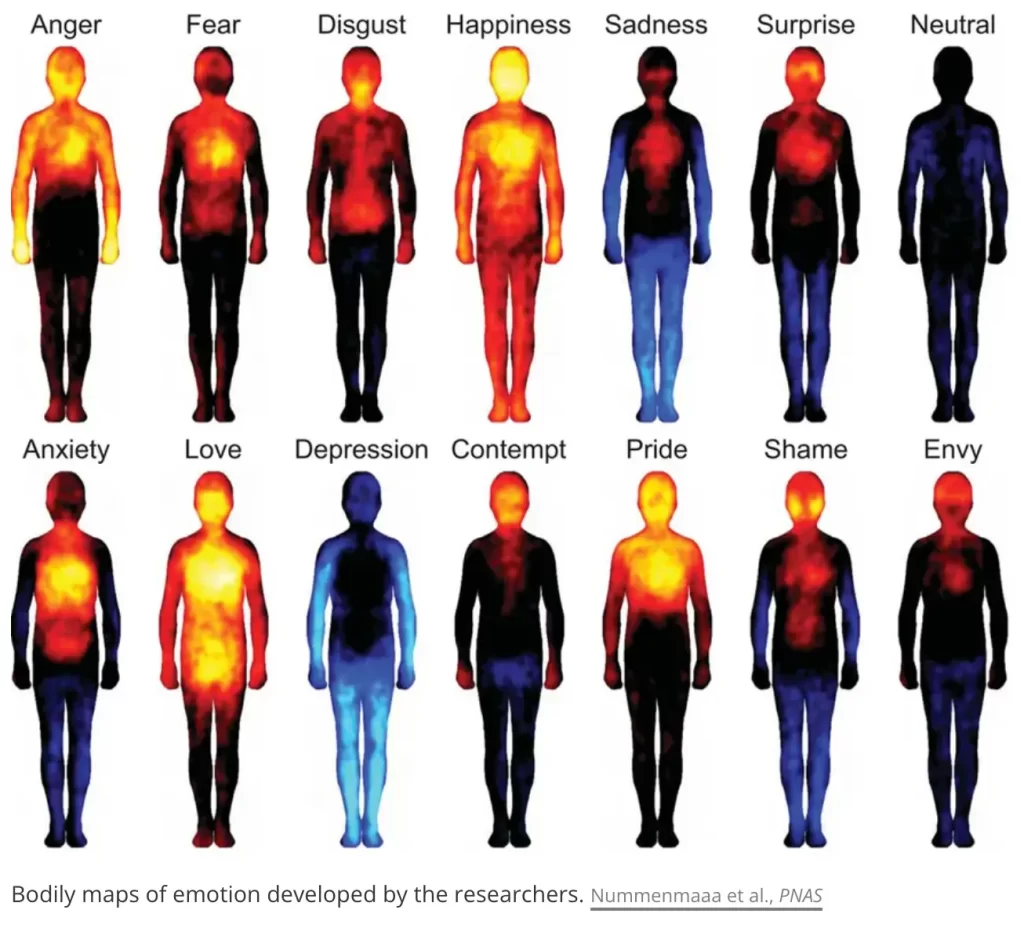
The map of where emotions live in the body isn’t metaphor. It’s biology.
The Myth About Chemistry
Here’s where most people — and, frankly, most of conventional medicine — get it backwards.
The dominant narrative in mental health for the last several decades has been the “chemical imbalance” theory: that depression is caused by low serotonin, that anxiety is caused by dysregulated neurotransmitters, that the chemistry is the problem and the pill is the fix.
What that model misses is the question of what changed the chemistry in the first place. No one ever asked if there was even a cascade higher then the actual “chemical Imbalance” itself.
Emotions alter your biochemistry — not the other way around. Chronic stress elevates cortisol. Unprocessed grief suppresses immune function. Repeated experiences of shame or fear create a neurochemical environment that, over time, reshapes the way your cells behave. The chemistry is downstream from the actual thought and or emotions that created it.
This matters enormously, because if you only treat the chemistry — without asking why the chemistry shifted — you’re working at the wrong end of the problem. You’re managing a symptom without touching the source.
I saw this play out for years in the mental health field. People cycling back through the same doors, same medications adjusted, same diagnoses confirmed. The label became the explanation. The chemical became the cause. And the experience that started it all was never part of the conversation.
What Does Any of This Have to Do With Your Genes?
This is where it gets genuinely surprising.
For a long time, we believed genes were static — a blueprint you were handed at birth, fixed and unchangeable. Epigenetics says something different. The word literally means “above the gene.” Epigenetic changes don’t alter the DNA sequence itself, but they do alter which genes get switched on and which stay quiet. Think of it like a dimmer switch rather than an on/off toggle.
And what controls the dimmer? The environment.
Not just the environment around you — the air, the food, the neighborhood — but the internal environment. The chemical soup your cells live in. Which, as we just established, is shaped significantly by your emotional state, your stress levels, your nervous system’s baseline.
Research published in Frontiers in Psychiatry (2026) found that epigenetic modifications associated with trauma can persist across multiple generations — meaning the stress your grandmother survived may have left a mark not just on her cells, but on yours. The mechanisms include changes in DNA methylation patterns and histone modifications, both of which affect how genes are read and expressed.
If this is correct then maybe that 90% of DNA that scientist were called “junk DNA” could be far from the truth and truly are a library of experience dated to the very beginning of your physical existence as a human.
You Are a Petri Dish
Cell biologist Dr. Bruce Lipton, well known for popularizing epigenetic, ran an experiment early in his career that changed how he understood human biology — and eventually led him to leave conventional research altogether.
He took genetically identical stem cells and split them into three separate petri dishes. For those that are unfamiliar with what a stem cell it is the very basic building blocks of all matter in your body and can turn into any cell (i.e. muscle, fat or bone cell). He placed the each with a different growth medium (the liquid environment the cells lived in). In the first dish, the cells grew into bone. In the second, muscle. In the third, fat.
Same genes. Three completely different outcomes. The only variable was the environment.
From that, Lipton drew a conclusion that sounds almost too simple: genes don’t determine destiny. The environment the cell lives in does.
He extended the analogy to the human body: we are, each of us, a skin-covered petri dish — a community of roughly 50 trillion cells, and the medium those cells swim in is determined by our blood chemistry, our nervous system, our beliefs, and our emotional patterns. When that internal environment is chronically flooded with stress hormones and fear signals, the cells respond accordingly. When it shifts — when the medium changes — so does the gene expression.
This is the bridge between trauma and healing that most people are never shown.
Can Trauma Actually Be Passed Down?
The short answer is: the evidence strongly suggests yes, though the research is still developing.
Studies of Holocaust survivors and their children found measurable differences in cortisol regulation and stress response markers in offspring who were never directly exposed to the original trauma. Similar findings have emerged in studies of famine survivors, war refugees, and communities with histories of sustained adversity.
The mechanism appears to involve epigenetic tags — chemical marks on the DNA that can influence how genes behave — that are sometimes passed from parent to child through the egg or sperm. The body, in a sense, prepares the next generation for the world it survived.
What’s remarkable about this isn’t the darkness of it. It’s what it implies about reversibility. If trauma can be encoded epigenetically, then healing — real healing, at the level of the nervous system and the subconscious — can begin to decode it.
What This Means for Healing
If your genes are responsive to environment — to the chemical signals your emotions send your cells — then changing the internal environment is a legitimate biological intervention. Not just a mindset shift. Not just “positive thinking.” Actual cellular biology.
This is why approaches that work at the level of the subconscious and nervous system matter. Not as alternatives to medicine — but as the missing layer that conventional mental health has largely left out.
Hypnotherapy, somatic work, nervous system regulation — these aren’t soft interventions. They are, in the language of epigenetics, attempts to change the medium the cells are living in. To replace the chronic cortisol signal with something else. To update the belief that told the body it wasn’t safe.
The Flexner Report of 1910 standardized Western medicine around a pharmaceutical and pathology-focused model, systematically removing nutrition, mind-body approaches, and root-cause medicine from the curriculum. We’re still living in the shadow of that decision. But the science has moved on. Epigenetics is peer-reviewed, published in major journals, and increasingly impossible to dismiss.
Your genes are not your destiny. They are, in many ways, waiting to see what kind of environment you put them in.
So what does this mean for you?
Knowing this changes something. Because if your internal environment — your chemistry, your nervous system’s baseline, the emotional residue living in your body — is the medium your genes respond to, then healing isn’t passive and there is a biological answer.
But here’s the part most people miss: you can’t change what you can’t access. And most of the beliefs and emotional patterns driving your chemistry aren’t sitting at the surface. They’re held in the body. In the parts of you that learned, long ago, to stay quiet.
This is where altered states of consciousness — trance, deep relaxation, hypnotherapy — become something more than a technique. When the analytical mind slows down and the subconscious becomes reachable, you’re not just having an experience. You’re entering the layer where those encoded signals live. The grief that never fully moved. The fear that calcified into a belief. The conclusion a younger version of you drew about your worth or your safety — and that your cells have been responding to ever since.
Getting underneath those patterns, hearing the subtle emotional messages the body has been holding, and beginning to update them — that is, I believe, how we speak to our genes. Through the internal environment we create when we finally let ourselves feel, process, and release what has been stored.
A good place to start is understanding what beliefs are actually running in the background — most people are surprised by what surfaces.
You cannot control what you don’t understand. The more clearly you see how your body works, the more agency you actually have over it.
Frequently Asked Questions
Can trauma change your DNA?
Trauma doesn’t change the DNA sequence itself, but it can alter how genes are expressed through epigenetic modifications — chemical tags that act like switches, turning certain genes on or off. These changes can affect stress response, immune function, and mental health, and in some cases may be passed to the next generation.
What is epigenetics in simple terms?
Epigenetics is the study of how your environment and experiences influence which of your genes are active. The DNA sequence stays the same, but chemical signals — including those generated by chronic stress, trauma, or emotional patterns — can switch genes on or off, changing how your cells behave.
Can epigenetic trauma changes be reversed?
Research suggests that epigenetic modifications are not permanent. Therapeutic approaches that regulate the nervous system, shift chronic stress patterns, and work at the subconscious level may influence the internal environment enough to support changes in gene expression over time. This is an active area of scientific investigation.
If this resonated, you might also read: Why Hypnotherapy Helps Trauma Without Reliving It or explore What\ Is the Subconscious Mind.
Ready to work at the level the patterns actually live? Book a consultation with Dr. Ann Marie Balkanski.