

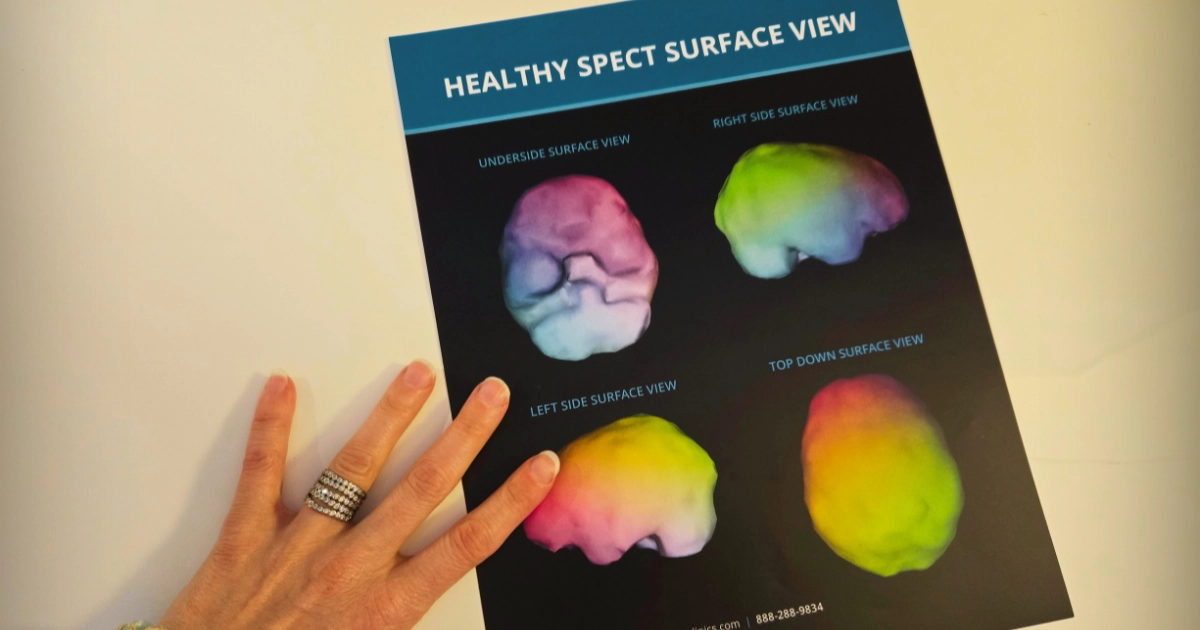

Trauma doesn’t just live in your memories — it changes the physical structure and activity of your brain. New research using SPECT brain imaging is making it possible to see those changes objectively, offering answers for people who have tried therapy, tried medication, and still feel something is wrong. Here’s what I observed at Amen Clinics — and what it means for how we treat trauma.
Trauma doesn’t just live in your memories — it changes the physical structure and activity of your brain. New research using SPECT brain imaging is making it possible to see those changes objectively, offering answers for people who have tried therapy, tried medication, and still feel something is wrong. Here’s what I observed at Amen Clinics — and what it means for how we treat trauma.
I recently toured the Amen Clinics after receiving a call from a doctor looking for an alternative therapy for his patient. My first thought was wow! I that is awesome you don’t meat many other provideors willing to go “outside the box” in a sence and find different approaches that were not nessesarily trained or one learns about in school. That is not to any fault of the providor is just that we get caught like a cog wheel in the system just doig what you know and what you been shown. And that rught there is what set Amen apart, and lead to my search about this clinicl the model and what they offer which i had no clue about before. There is a saying i like to say “you don’t know what you don’t know” and i was open to understyanding what they did.
So I went on a visit to check them out locally, although they have clinics all over, to my surprise I already had a few clients I am working with that have done the scans that week from Amen which I will share shortly. Amen focuses heavily on SPECT imaging which I have knonw about but something didn’t click until I walked into that clinic.
Standing in front of their brain scans — thousands of them — something landed that I’m surprised hadn’t landed sooner. Psychiatry is the only field in medicine that diagnoses without imaging. A cardiologist won’t treat a heart condition without an EKG. An orthopedist won’t set a bone without an X-ray. But in behavioral health, we listen to symptoms, match them to a checklist, and assign a label. No scan. No biomarker. No objective picture of what’s actually happening inside the organ we’re trying to treat.
That isn’t a criticism of any provider. It’s simply how we’re trained. The tools haven’t been accessible enough to become standard. But they’re getting closer — and what they’re showing us matters.
The Question My Clients Are Really Asking
If you’ve ever sat across from a therapist or psychiatrist and thought, this is helpful, but something still isn’t moving — you’re not alone, and you’re not wrong.
The question underneath almost every intake I do isn’t “can you fix me.” It’s something more specific. It sounds like:
Why do I still feel stuck, even after all this work?
Why does my body still feel uneasy, even when nothing is actually wrong right now?
What is actually happening in me?
Those aren’t rhetorical questions. They’re diagnostic ones. And the fact that traditional psychiatry has no objective tool to answer them — no scan, no biomarker, no image — means that a lot of people are left carrying the confusion alongside the symptom. Told it’s depression. Told to try a different medication. Told it might just be anxiety. And still wondering.
This is what made walking through Amen Clinics feel less like a tour and more like a recognition. Because what their database of nearly 300,000 brain scans is doing, at its core, is trying to answer that proverbial question. Not with guesswork. With data.
What Trauma Actually Does to the Brain
Before we talk about imaging, let’s be clear about something: trauma is not a story you tell yourself. It is a physical event. It changes the brain.
Research published in the Journal of Psychiatric Research confirms that trauma and PTSD produce measurable, structural changes in the brain — particularly in the prefrontal cortex, hippocampus, and amygdala. Gray matter reduction. Altered blood flow. Hyperactivation in the limbic system. These are not metaphors. They are findings on a scan.
This is why the phrase “it’s all in your head” is both technically true and completely misleading. Yes, it’s in the head. But it’s in the head the same way a broken bone is in the arm. It is a physical change to a physical organ — and it shows up when you look.
The problem is that in standard psychiatric practice, we rarely look.
Can Brain Imaging for Trauma Diagnosis Actually Work?
This is where SPECT imaging — Single Photon Emission Computed Tomography — becomes genuinely fascinating. SPECT doesn’t just show brain structure. It measures real-time blood flow and activity across the brain. And what that reveals, particularly for trauma, is strikingly specific.
A peer-reviewed study published in PLOS ONE analyzing over 20,000 patients found that SPECT could distinguish between traumatic brain injury (TBI) and post-traumatic stress disorder (PTSD) with approximately 89% accuracy. That matters enormously, because these two conditions present almost identically on a symptom checklist — anxiety, memory issues, emotional dysregulation, sleep disruption — but look nearly opposite on a scan.
TBI shows reduced blood flow in specific regions from physical damage. PTSD shows hyperactive blood flow, particularly in the limbic system — the emotional processing center of the brain. Same presentation. Completely different picture underneath. Getting this wrong means treating someone for years with an approach that doesn’t match what’s actually happening in their brain. That’s not a small error. That’s the difference between someone healing and someone cycling through the same door.
The same principle applies to ADHD. Research using SPECT in large adult ADHD populations has identified distinct neurological patterns that map onto significantly different treatment responses. One pattern shows classic underactivity in the prefrontal cortex. Another — called “Ring of Fire” — shows widespread overactivity that can look like bipolar disorder on a questionnaire alone. A stimulant that helps one subtype can worsen another. Same diagnosis on paper. Completely different brain.
This is what precision medicine in behavioral health could look like. It doesn’t exist at scale yet, but it’s pointing toward something important: that the “not all in your head” question your clients and patients are quietly asking may be answerable in ways it never was before.
What Meditation — and Altered States — Actually Look Like in the Brain
Here’s something I wasn’t expecting to be as moved by as I was: the imaging on meditation.
Neuroscientist Andrew Newberg used SPECT to study experienced meditators and found real, visible, reproducible changes — decreased activity in the parietal lobe, and significantly increased blood flow to the prefrontal cortex and thalamus. An 8-week meditation program produced measurable increases in cerebral blood flow to regions tied to memory and attention.
We talk about mindfulness constantly in this field. Here is what it looks like in the organ it’s actually changing.
As a hypnotherapist, this is where my attention sharpened considerably. Because the kind of deep subconscious work I do with clients — the altered states, the inner child work, the accessing of material that lives beneath conscious awareness — also shifts brain states in ways that are increasingly measurable. Altered states of consciousness, whether through meditation, hypnotherapy, or emerging psychedelic-assisted modalities, are not soft science. They are producing observable changes in a physical organ. The conversation about why they work is becoming a conversation we can see.
I also asked the team at Amen Clinics about psychedelics. They are in the early stages of imaging how psychedelic-assisted therapies affect the brain — and I cannot wait to see what that data looks like. Advocacy without evidence is just enthusiasm. What gets me genuinely excited is when we can see what a therapy is doing, because that’s how we build the kind of rigorous support that moves an approach from the fringe into real clinical practice.
What I Believe This Means — And What It Doesn’t
I want to be honest about the limitations here, because intellectual honesty is part of what makes any approach credible.
SPECT imaging isn’t widely covered by insurance. Cost is a genuine barrier for most people. The broader scientific community continues to debate the clinical applications, and Amen Clinics has its critics within academic psychiatry. They also have a supplement line, which some interpret as a conflict of interest — and yes, it is a business, operating outside the structures that conventional insurance-driven care supports.
All of that is worth knowing.
But here’s what I keep coming back to: Amen’s whole-person model — looking at nutrition, toxin exposure, and lifestyle alongside imaging — is something I genuinely resonate with. Not because supplements replace good food and good soil. Nothing does. But because treating a person as a system rather than a checklist is closer to how healing actually works. And for someone who has been told for years that their suffering is vague, unexplained, or “treatment-resistant” — seeing their own brain scan can be the first time something external validates what they already knew: something is actually different in here, and different has a path forward.
That kind of validation can be a turning point.
If You’re Still Asking “Why Do I Feel This Way”
You’re not broken. You’re not failing therapy. You may simply not have had access to the right lens yet.
The work I do with clients — hypnotherapy, subconscious reprogramming, inner child work, parts work — targets the same territory that brain imaging is beginning to make visible. The patterns beneath the symptom. The place where trauma has been stored not as memory alone, but as physiological reality in the body and nervous system.
You don’t need a SPECT scan to begin. But if you’re someone who has done the work and still feels uneasy in your body, still feels stuck, still feels like something isn’t adding up — it may be time to go underneath what the conscious mind can see on its own.
We have more options than we realize. The challenge is that our field hasn’t always been good at staying current with what those options are, connecting the dots between disciplines, or building access to innovative care. Something needs to change for us to evolve — and I think it starts with being curious enough to look beyond what we’ve always done.
This was my first visit to Amen Clinics. It won’t be my last exploration of what else is out there.
Frequently Asked Questions
Can brain imaging diagnose trauma or PTSD?
Brain imaging tools like SPECT cannot diagnose trauma or PTSD on their own, but peer-reviewed research shows they can distinguish between conditions that present similarly — such as PTSD and traumatic brain injury — with significantly higher accuracy than symptom-based evaluation alone. They provide objective data about brain activity that supports more precise, individualized treatment decisions.
Why do I still feel anxious or stuck after years of therapy?
Talk therapy primarily works through conscious insight. Trauma, however, is often stored in the subconscious mind and nervous system — in limbic pathways and physiological responses that cognitive processing alone doesn’t reliably reach. Modalities that access deeper brain states, such as clinical hypnotherapy or somatic work, may address what talk therapy cannot because they work beneath the level of conscious thought.
What is SPECT brain imaging and how is it different from an MRI?
SPECT — Single Photon Emission Computed Tomography — measures real-time blood flow and activity across the brain, showing function rather than structure. Unlike an MRI, which images anatomy, SPECT shows which areas are underactive, hyperactive, or responding differently to specific conditions. Research has used SPECT to identify distinct brain patterns in PTSD, TBI, ADHD subtypes, and the neurological effects of meditation and other therapeutic approaches.
Dr. Ann Marie Balkanski, MD, is a certified clinical hypnotherapist based in Fort Lauderdale, FL, working with clients in person and virtually worldwide. Her practice focuses on trauma, anxiety, subconscious reprogramming, and the patterns that talk therapy couldn’t reach.
If this resonated, you might also read: Hypnotherapy vs. Talk Therapy — What’s the Difference