



Hypnotherapy and talk therapy both treat anxiety and trauma — but they work at different levels of the mind. Talk therapy (including CBT) primarily works at the conscious level: identifying thought patterns, building awareness, and developing coping strategies. Hypnotherapy works at the subconscious level: accessing the emotional memory, fear files, and automatic nervous system responses that drive anxiety and trauma reactions before the conscious mind can intervene. For people who already understand their patterns but still feel controlled by them, hypnotherapy tends to reach what talk therapy hasn’t. For people who need structure, ongoing processing, or cognitive skill-building, talk therapy may be the right starting point — or a strong complement. Neither is universally superior; the question is which level of mind needs to change.
If you’re already considering therapy, you’re ahead of where most people start. But if you’re in Fort Lauderdale or Hollywood weighing hypnotherapy against talk therapy—wondering which one actually works, which one is faster, which one goes deeper—you deserve a clear-eyed answer, not a sales pitch for either side.
Both approaches help people. They work differently. And for anxiety and trauma specifically, understanding that difference matters.

How Talk Therapy Works?
Talk therapy—whether CBT, psychodynamic, EMDR, or person-centered—primarily operates at the level of the conscious mind. The goal is to bring patterns into awareness, understand them, challenge them, and build new ways of thinking and responding.
CBT (Cognitive Behavioral Therapy), one of the most researched approaches, focuses on identifying distorted thought patterns and replacing them with more accurate ones. For many people, this is genuinely helpful—especially for situational anxiety, phobias with clear external triggers, and building coping tools.
Talk therapy works best when:
- The person has enough emotional stability to examine thoughts from the outside
- Insight alone can shift behavior
- The anxiety or trauma is relatively accessible to language and reflection
- A long-term, ongoing therapeutic relationship is the right structure
The limitation is this: the conscious mind—where talk therapy primarily operates—represents roughly 10% of the mind’s total processing. Anxiety and trauma live deeper.
How Hypnotherapy Works?
Hypnotherapy works by entering a calm, focused state—not unconscious, not “out”—where the analytical, resistant layer of the conscious mind steps aside slightly. In that state, the subconscious becomes more accessible.
Think of it using the iceberg model. Talk therapy works on the part above the water: awareness, reasoning, reframing. Our Hypnotherapy Sessions in Fort Lauderdale reaches below the surface: emotional memory, learned beliefs, body-based fear responses, and the automatic programs the subconscious runs to keep you safe.
The subconscious is the hard-drive mind. It stores experiences—especially emotionally charged ones—and uses them to predict what will happen next. It doesn’t update those predictions automatically. It needs direct access. That’s what hypnotherapy provides.
Hypnotherapy works best when:
- Insight is already present but behavior hasn’t changed
- Anxiety feels automatic—not chosen, not conscious
- Trauma patterns are rooted in emotional memory rather than explicit narrative
- The person wants depth work, not just coping strategies
- Progress has stalled in other approaches despite genuine effort
Frequently Asked Questions
Is hypnotherapy better than CBT?
Not categorically. CBT is well-researched and effective for many people. Hypnotherapy tends to offer an advantage when anxiety or trauma is rooted in subconscious emotional memory that insight and cognitive reframing haven’t fully reached. The two approaches can also work well together.
Does hypnotherapy work for PTSD?
Yes, for many presentations. Trauma-informed hypnotherapy can address the subconscious fear files, body responses, and implicit memories associated with PTSD without requiring prolonged graphic retelling.
How is a hypnotherapy session different from a therapy session?
A talk therapy session typically stays in conversational, conscious-mind exchange. A hypnotherapy session includes a relaxation induction that shifts the state of attention—allowing work at the subconscious level. Both involve talking, but hypnotherapy uses that shift in state to access material that pure conversation often doesn’t reach.
Can hypnotherapy replace therapy?
For some people, yes. For others, it works best alongside therapy. It depends on the issue, history, and what kind of support the person needs. Ann Marie’s sessions are individualized—not scripted—and the approach is based on what each client actually needs.
Where They Differ: The Level of Access
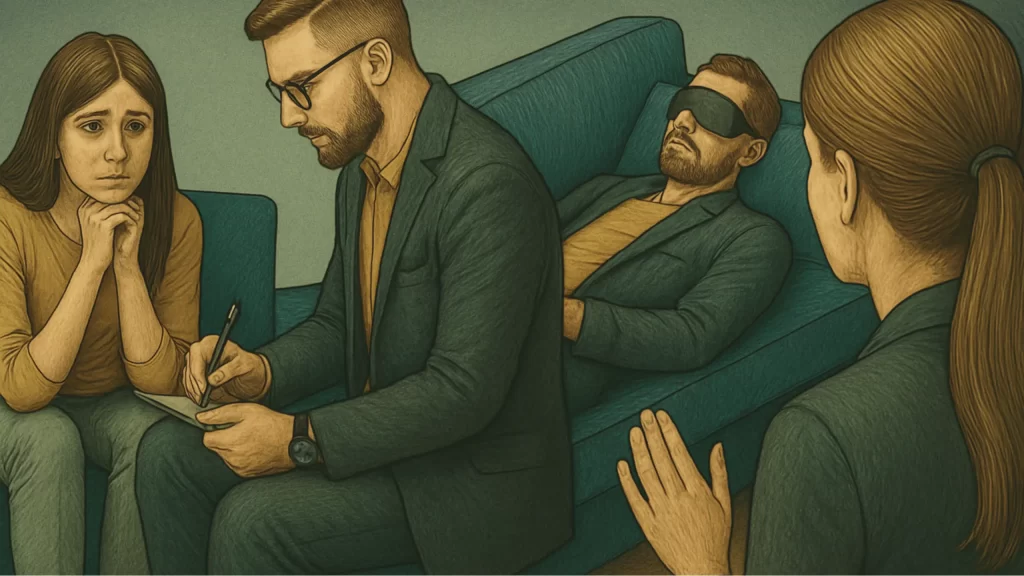
The core distinction between hypnotherapy sessions and talk therapy is the level of mind being addressed.
Talk therapy works with what you can articulate—the thoughts, the narrative, the patterns you can observe and describe. Hypnotherapy works with what’s driving behavior before articulation: the emotional file, the body memory, the subconscious prediction.
This is not a criticism of talk therapy. For many situations, conscious-level work is exactly right. But for anxiety and trauma that persist despite insight—when you already “know why” and still feel it—the gap is usually between conscious understanding and subconscious programming. That gap is where hypnotherapy tends to be most useful.
The Research Perspective
The evidence base for talk therapies—especially CBT—is extensive and well-established. The American Psychological Association outlines CBT as a first-line treatment for anxiety disorders and provides detailed documentation on Prolonged Exposure for PTSD (apa.org/ptsd-guideline/treatments/prolonged-exposure).
The evidence base for hypnotherapy is growing. A 2019 meta-analysis published in Neuroscience & Biobehavioral Reviews found hypnosis to be effective for anxiety reduction. Research from Stanford has demonstrated measurable brain changes during hypnosis, consistent with the subjective experience of “quieting” the analytical mind.
Importantly, many evidence-based trauma treatments—including EMDR—operate on similar principles to hypnotherapy: using states of focused, altered attention to process material that verbal recounting alone doesn’t reach.
CBT Specifically: Strengths and Limitations for Anxiety and Trauma
CBT is valuable. Its tools—thought records, behavioral experiments, exposure hierarchies—genuinely help people build different responses to anxiety. For mild-to-moderate anxiety with identifiable cognitive distortions, it’s often an excellent fit.
Where CBT can reach a plateau: when the emotional charge underneath the thought pattern hasn’t shifted. A person can know that “catastrophizing” is happening and still catastrophize. They can complete an exposure exercise and still feel flooded. The thought has changed. The emotional file hasn’t.
This is where hypnotherapy can complement or build on CBT—by accessing the subconscious beliefs that cognitive work alone hasn’t reached. Specifically, hypnotherapy for anxiety in Fort Lauderdale is often sought by people who’ve already done CBT and want to go deeper.
For Trauma: Key Differences
Trauma treatment is where the difference between talk therapy and hypnotherapy becomes most significant.
Talk therapy for trauma often requires detailed verbal retelling—narrating the experience, staying with distress while processing it. Prolonged Exposure, Cognitive Processing Therapy, and similar approaches are effective for many people. But they require a level of window-of-tolerance stability that not every trauma survivor has initially.
Trauma-informed hypnotherapy can target the same patterns—the emotional meaning, the body response, the subconscious belief—without necessarily requiring graphic retelling. This makes it a gentler entry point for some trauma presentations. Learn more about this approach in hypnotherapy for trauma without reliving it.
It’s also worth noting that trauma often lives in implicit memory—body memory, emotional reflex, subconscious prediction—rather than in explicit narrative. Approaches that engage that implicit level tend to reach it more directly.
Can You Do Both? Integrating Approaches
Yes—and many clients do. Talk therapy and hypnotherapy aren’t mutually exclusive. Some people work with a talk therapist for ongoing support and structure while doing hypnotherapy for specific pattern work. Others transition from talk therapy when they’ve gained insight but feel stuck on the “doing different” part.
Ann Marie’s medical background informs an evidence-aware approach. The goal is what actually helps the person in front of her—not advocacy for a single method.
Which Is Right for You?
A few honest questions to help you think it through:
- Do you already understand your patterns but still feel controlled by them? → Hypnotherapy may reach what insight hasn’t.
- Is your anxiety situational and manageable? → CBT or structured talk therapy may be sufficient.
- Have you tried talk therapy and felt it helped you understand but not fully change? → That gap is where subconscious work tends to operate.
- Is your trauma response primarily physical—body memory, automatic reactions, dissociation? → Somatic-informed hypnotherapy is often a strong fit.
- Do you want ongoing processing and a long-term therapeutic relationship? → Talk therapy may be the better structure.